ラベル Japan May and June 2010 の投稿を表示しています。 すべての投稿を表示
ラベル Japan May and June 2010 の投稿を表示しています。 すべての投稿を表示

2013/04/21
Summer Holiday in Japan in May & June 2010 (Enhanced Version) ~ Part 3
Welcome to the third section of the revised version of my summer vacation in Japan in May & June 2010. There will be a total of five focus topics that will be covered in this section: Our first visit to the Gotemba Premium Outlets, Sampling the Limited Express Narita Express to Narita International Airport, spending a day of driving and exploring Nikko, a special birthday trip to Kobe in celebration of my 15th birthday and spending nature in Atami near the Izu Peninsula.
Part 1 ~ Our First Trip Towards the Gotemba Premium Outlets
On the morning of Tuesday (1 June), all of us woke up at around 9.30 a.m. after having a well-earned good night's sleep. Having a shower and changing into our attires for the day, my parents informed us that we would be taking a day trip towards the Gotemba Premium Outlets on this day.
With all our necessary belongings ready after breakfast, we took the elevator down to the main apartment lobby, arriving there by ten o' clock. From the entrance towards the Somerset Serviced Apartments Roppongi Tokyo, we flagged down a cab, and told the driver to take us towards Tokyo Station. Soon enough, we left the Somerset Serviced Apartments Roppongi Tokyo by 10.10 a.m. for a short 20-minute taxi ride towards Tokyo Station.
Upon arrival at Tokyo Station by 10.30 a.m., we immediately proceeded to the JR Central Ticket Office to purchase our in-bound tickets for the in-bound segment towards Gotemba. According to my mum, our itinerary for the in-bound journey to Gotemba would be to catch the Shinkansen HIKARI Superexpress No. 469 bound for Okayama, which would depart Tokyo Station at 11.03 a.m., and arrive at Mishima Station at 11.47 a.m.. Upon arriving at Mishima Station, we would connect to a JR Tokaido Main Line towards Numazu, and transfer to the JR Gotemba Line for the final segment towards Gotemba at Numazu Station.
Tokyo Station (東京駅) is a railway station located in the Marunouchi business district in Chiyoda-ku, Tokyo, Japan. It is the main intercity railway terminal serving the national capital of Japan, and the busiest railway terminal in Japan in terms of the number of trains, with at least 3,000 serving the station. Many of the high-speed Shinkansen services start and terminate at the station.
The station also serves as the starting point for the Tokaido Main Line, Yokosuka Line, Sobu Main Line (Rapid), Keiyo Line and Chuo Main Line, as well as a major stop along the Keihin-Tohoku Negishi Line, Yamanote Line and the Tokyo Metro Marunouchi Line. Several limited express trains bound for the Izu and Boso Peninsulas also start and terminate here. The Narita Express limited express service towards Narita International Airport also stops here.
The Tokaido Shinkansen (東海道新幹線) is a high speed Shinkansen line operated by Central Japan Railway Company (JR Central) linking between the major cities of Tokyo and Osaka in Japan. Opened on 1 October 1964, it is the oldest Shinkansen line in Japan, and the most heavily-travelled high-speed railway line in the world, with 5.3 billion passengers travelling on it between 1964 and 2012. The line has a maximum top speed of 270 km/h (170 mph).
As of 16 March 2013, 16-car 700 series and N700 series sets operate on the line on the various NOZOMI, HIKARI and KODAMA services. Many of the NOZOMI and HIKARI services offer direct service to the Sanyo Shinkansen beyond Shin-osaka Station as far as Okayama, Hiroshima and Fukuoka. NOZOMI trains are not covered under the Japan Rail Pass. The line is also scheduled to celebrate its 50th anniversary in 2014.
HIKARI (ひかり) is a high-speed train service that operates on the Tokaido & Sanyo Shinkansen lines in Japan. Slower than the NOZOMI but faster than the KODAMA, the HIKARI is the fastest train service on the Tokaido & Sanyo Shinkansen lines that can be used with the Japan Rail Pass. The service is capable of reaching a top speed of 300 km/h (186 mph).
The service commenced on 1 October 1964, in collaboration with the opening of the Tokaido Shinkansen line, using 0 series equipment until their ultimate retirement from these services on 14 December 2008. From 1985, 100 series sets were introduced on these services, along with 300 series sets in 1992, until they were retired from revenue service on 16 March 2012.
From late 2000, 700 series sets were introduced on these services, displacing the older 300 series sets used on these service by 16 March 2012. From 15 March 2008, newer N700 series sets were introduced on some of these services. All services operated by new N700 series trains are completely non-smoking, with smoking permitted only in the enclosed smoking areas available in Cars No. 3, 7, 10 and 15.
A special promotional service, known as HIKARI Rail Star (ひかりレールスター), was introduced by West Japan Railway Company (JR West) on 11 March 2000. The service was introduced to provide competition against airliners between the cities of Osaka and Fukuoka. It mainly uses special 8-car 700 series sets painted grey with black stripes over the windows, separated by a sunny yellow stripe.
The service is limited to the Sanyo Shinkansen line and operates at a top speed of 285 km/h (177 mph). Green Car (first class) accommodation is not available on these services, though the reserved seating cars are arranged in a 2-2 seating configuration. From the start of the revised timetable on 17 March 2012, HIKARI Rail Star services using the special 8-car 700 series sets became entirely non-smoking.
After purchasing our Green Car (first class) Shinkansen tickets from the JR Central Ticket Office, the clock was finally showing 10.40 a.m.. Being sure to have all our belongings with us, we went through the ticket gates and went to check the departure information board to see which platform the Shinkansen HIKARI Superexpress No. 469 bound for Okayama would depart from.
According to the departure information board, the Shinkansen HIKARI Superexpress No. 469 bound for Okayama would depart at 11.03 a.m. from Track No. 16. Since we had only 15 minutes left before our train towards Mishima, we immediately headed towards a nearby station kiosk to purchase some food and beverages for our trip.
Soon enough, we finally took the escalators up towards Tracks No. 16 and 17, arriving there by 10.50 a.m.. On the platform, we found a 16-car JR West 700 Series Shinkansen Set No. B15 on Track No. 16. The train had arrived from Nagoya as the Shinkansen KODAMA Superexpress No. 634 earlier, and was still undergoing extensive cleaning before forming the Shinkansen HIKARI Superexpress No. 469 bound for Okayama.
Mishima Station (三島駅) is the main railway station serving the suburban city of Mishima, Shizuoka, Japan. The station serves as a transferring station for the Tokaido Shinkansen, Tokaido Main Line and Izuhakone Railway Sunzu Line. All KODAMA trains, as well as some HIKARI trains, stop here. Several early morning and late night KODAMA services also start and terminate here.
Part 2 ~ Sampling the Limited Express Narita Express to Narita International Airport
The Narita Express (成田エクスプレス) is a limited express train service operated by East Japan Railway Company (JR East) between Narita International Airport and the Greater Tokyo Area in Japan. The service frequency is approximately every 30 minutes, with some services stopping at Chiba, Yotsukaido and Narita Stations in the early morning and evening hours. The service is capable of reaching a top speed of 130 km/h (80 mph).
The service commenced operations on 19 March 1991, using 253 series EMUs in either 3-car or 6-car formations. These sets were frequently coupled together between Tokyo and Narita International Airport. From 1 October 2009, new E259 series EMUs were introduced on these services, replacing the older 253 series EMUs by 30 June 2010.
Green private compartments were available on services operated by the older 253 series EMUs. These were eventually phased out on 30 June 2010, as the new E259 series EMUs do not feature these compartments. There is no extra charge for the Narita Express for tourists travelling with a Japan Rail Pass.
However, following the Great East Japan Tsunami on 11 March 2011, all Narita Express services were completely suspended until further notice. They were partially restored on 4 April 2011, until the pre-earthquake and tsunami timetable and services were finally reinstated on 3 September 2011.
Part 3 ~ Spending a Day in Nikko
I was rather excited, since this would mark our first time riding on the Tohoku Shinkansen line. Since this was in the middle of 2010, the Tohoku Shinkansen line extension between Hachinohe and Shin-aomori was still not opened at that time.
The Tohoku Shinkansen (東北新幹線) is a Japanese high-speed Shinkansen line operated by East Japan Railway Company (JR East) between Tokyo and Aomori in Japan. Opened in stages between 1982 and 2010, it is the longest Shinkansen line in the nation, with a total length of 674 kilometres (419 miles).
The line mainly passes through several less developed areas in the Tohoku Region, and has two mini-Shinkansen lines, the Akita and Yamagata Shinkansen lines. The line runs merged with the Joetsu and Nagano Shinkansen (Hokuriku Shinkansen) lines between Tokyo and Omiya Stations. The line is capable of a maximum speed of 320 km/h (200 mph), like the TGV high-speed lines operating in France.
However, on the dreaded afternoon of 11 March 2011, all Tohoku Shinkansen services were suspended following the Great East Japan Earthquake & Tsunami. The line was re-opened in stages between 15 March 2011 and 29 April 2011, but at lower speeds due to repair works being conducted along the line. The pre-earthquake and tsunami services and timetable were finally reinstated on 23 September 2011, after approximately five months of re-construction works.
The Nagano Shinkansen (長野新幹線) is a high-speed Shinkansen line operated by East Japan Railway Company (JR East) between the cities of Tokyo and Nagano in Japan. It was opened on 1 October 1997, in preparation for the 1998 Winter Olympics held in Nagano. The line also forms the first segment of the Hokuriku Shinkansen (北陸新幹線), which is currently under construction, with the section between Nagano and Kanazawa scheduled to be opened by mid-2015. The line has a maximum top speed of 260 km/h (160 mph).
As of 16 March 2013, a dedicated fleet of 14 8-car E2 series sets operate on the line on ASAMA services at a top speed of 260 km/h (160 mph), with the stop patterns varying for each of the services. The fastest journey time between Tokyo and Nagano takes just 1 hour 23 minutes.
However, with the opening of the sector between Nagano and Kanazawa by mid-2015, new 12-car E7 series and W7 series trains will be introduced on the new KAGAYAKI (Tokyo to Kanazawa limited-stop), HAKUTAKA (Tokyo to Kanazawa all-stations) and TSURUGI (Toyama to Kanazawa shuttle service) services. The existing 8-car E2 series sets will still be retained on the existing ASAMA services between Tokyo and Nagano when the line is extended. At the same time, the line will be operated jointly by East Japan Railway Company (JR East) and West Japan Railway Company (JR West).
YAMABIKO (やまびこ) is a high-speed Shinkansen train service operated by East Japan Railway Company (JR East) on the Tohoku Shinkansen line between Tokyo and Morioka in Japan. The service generally stops along the stretch between Tokyo and Sendai, and at every station between Sendai and Morioka. The service is capable of reaching a top speed of 275 km/h (170 mph).
The service commenced operations on 23 June 1982, in collaboration with the opening of the Tohoku Shinkansen line, using 200 series sets at a top speed of 240 km/h (150 mph), until they were retired from these services on 19 November 2011. From 15 July 1994, 12-car E1 series sets (branded as Max YAMABIKO) were introduced on these services at a top speed of 240 km/h (150 mph) until they were withdrawn from all Tohoku Shinkansen services on 4 December 1999.
From 22 March 1997, E2 series sets were introduced on these services at a top speed of 275 km/h (170 mph). Services operated by these sets frequently ran coupled with Akita Shinkansen KOMACHI services, operated by E3 series sets, between Tokyo and Morioka. However, following the opening of the Tohoku Shinkansen line extension to Hachinohe and Shin-aomori in late 2002 and 2010, all Akita Shinkansen KOMACHI services ran coupled with newer HAYATE services between Tokyo and Morioka.
From 20 December 1997, 8-car E4 series sets (also branded as Max YAMABIKO) were introduced on these services, operating at a maximum speed of 240 km/h (150 mph). These sets frequently ran coupled with Yamagata Shinkansen TSUBASA services between Tokyo and Fukushima, until 28 September 2012.
From 19 November 2011, E5 series sets were introduced on these services, eventually displacing the remaining older 200 series sets running on the Tohoku Shinkansen line. This eventually allowed GranClass, a special type of train accommodation that is beyond Green Cars, to be introduced on some services. While there are no extra charges required for the YAMABIKO with the Japan Rail Pass, Japan Rail Pass holders planning to use GranClass must pay the Shinkansen express charge, in addition to the GranClass surcharge.
Utsunomiya Station (宇都宮駅) is the main railway station serving the city of Utsunomiya, Tochigi, Japan. The station serves as an interchange station for the Tohoku Shinkansen, Tohoku Main Line (Utsunomiya Line), Shonan-Shinjuku Line, Nikko Line and Karasuyama Line. Tobu Utsunomiya Station is located approximately 1.6 kilometres to the west of Utsunomiya Station itself.
Part 4 ~ My 15th Birthday Celebration Day Trip Towards Kobe
My itinerary for the in-bound segment towards Kobe would be to catch the Shinkansen NOZOMI Superexpress bound for Hakata (Fukuoka), which would depart Tokyo Station at 12.30 p.m., and arrive at Shin-osaka Station at 3.06 p.m.. The rest of my family would then follow on the Shinkansen HIKARI Superexpress No. 513 bound for Shin-osaka, which would depart Tokyo Station at 12.33 p.m., and arrive at the Shin-osaka terminal station at 3.30 p.m.. Upon arriving at Shin-osaka Station, we would connect to a Special Rapid Service train for the final segment towards Kobe.
NOZOMI (のぞみ) is the fastest train service operating on the Tokaido Shinkansen and Sanyo Shinkansen lines in Japan. The service generally stops at the largest stations on the Tokaido Shinkansen line, and along the stretch on the Sanyo Shinkansen line. The service has a top speed of 300 km/h (186 mph), with the fastest service taking only 2 hours 25 minutes between Tokyo and Shin-osaka, and 4 hours 50 minutes between Tokyo and Hakata (Fukuoka).
The service commenced operations on 14 March 1992, using 300 series sets at a top speed of 270 km/h (170 mph), until they were ultimately retired from revenue service on 16 March 2012. From 22 March 1997, 500 series sets were introduced on these services at a top speed of 300 km/h (186 mph), until they were gradually retired from these services on 28 February 2010.
From 13 March 1999, 700 series sets were introduced on these services at a top speed of 285 km/h (177 mph). From 1 July 2007, N700 series sets were introduced on these services at a top speed of 300 km/h (186 mph), like the 500 series sets. There is no smoking permitted on the services operated by N700 series sets, with smoking permitted only in enclosed smoking areas in Cars No. 3, 7, 10 and 15 of the 16-car formation.
Since the start of the revised timetable on 13 March 2010, all through regular NOZOMI services towards Okayama, Hiroshima and Hakata (Fukuoka) were operated by new N700 series sets. From the start of the revised timetable on 17 March 2012, all regularly-scheduled NOZOMI services, including runs limited to the Tokaido Shinkansen line, were operated by newer N700 series trains.
The NOZOMI service is not valid for tourists travelling with a Japan Rail Pass. Payment of the basic fare and the Shinkansen express charge is a mandatory pre-requisite to use NOZOMI trains, including the Green Car (first class) surcharge when using a Green Car (first class) seat, even if you have a Japan Rail Pass.
Shin-osaka Station (新大阪駅) is a major railway station located in Yodogawa-ku, Osaka, Japan, and is one of the central railway terminals serving the Keihanshin metropolitan area. The station was opened on 1 October 1964, in collaboration with the opening of the Tokaido Shinkansen, since there was no space for a Shinkansen station in the city centre itself. The station serves as an interchange station for the Tokaido and Sanyo Shinkansen, JR Kyoto Line (Tokaido Main Line) and Osaka Municipal Subway Midosuji Line.
Many Shinkansen trains offer through service on the Tokaido and Sanyo Shinkansen lines through this station. The station also serves as a starting and ending point for direct Sanyo Shinkansen trains bound for the Kyushu Shinkansen line. On 16 March 2013, an additional Shinkansen platform (Track No. 27) was opened for service in order to ease overcrowding at the station. Track No. 27 is the only Shinkansen platform in the station to have half-height automatic platform screen doors.
Sannomiya Station (三ノ宮駅 / 三宮駅) is a railway station located in Chuo-ku, Kobe, Hyogo, Japan. It is the central railway terminal serving the urban port city of Kobe, and is located on the JR Kobe Line, Hankyu Kobe Line, Hanshin Main Line, Seishin-yamate Subway Line and the Port Liner. The Japanese name for the Sannomiya Station by JR West is written as 三宮駅, whereas for all other railway lines, it is written as 三宮駅.
The station name for the JR Kobe Line includes the katakana character 'no (ノ)' to avoid misreadings by foreign tourists and other locals from the country. Nishinomiya Station also included that particular katakana character, and its Japanese name was written as 西ノ宮駅.
However, for many years, the city of Nishinomiya had been legally requesting for the Japanese name of the station to be changed, in order to match the city's name. Finally, on 18 March 2007, in collaboration with the opening of Sakura-shukugawa Station, the station was renamed as 西宮駅, for the sake of the city. But, to avoid further reading confusions, I will continue to write the Japanese name for Nishinomiya Station operated by JR West as 西ノ宮駅.
Part 1 ~ Our First Trip Towards the Gotemba Premium Outlets
On the morning of Tuesday (1 June), all of us woke up at around 9.30 a.m. after having a well-earned good night's sleep. Having a shower and changing into our attires for the day, my parents informed us that we would be taking a day trip towards the Gotemba Premium Outlets on this day.
With all our necessary belongings ready after breakfast, we took the elevator down to the main apartment lobby, arriving there by ten o' clock. From the entrance towards the Somerset Serviced Apartments Roppongi Tokyo, we flagged down a cab, and told the driver to take us towards Tokyo Station. Soon enough, we left the Somerset Serviced Apartments Roppongi Tokyo by 10.10 a.m. for a short 20-minute taxi ride towards Tokyo Station.
Upon arrival at Tokyo Station by 10.30 a.m., we immediately proceeded to the JR Central Ticket Office to purchase our in-bound tickets for the in-bound segment towards Gotemba. According to my mum, our itinerary for the in-bound journey to Gotemba would be to catch the Shinkansen HIKARI Superexpress No. 469 bound for Okayama, which would depart Tokyo Station at 11.03 a.m., and arrive at Mishima Station at 11.47 a.m.. Upon arriving at Mishima Station, we would connect to a JR Tokaido Main Line towards Numazu, and transfer to the JR Gotemba Line for the final segment towards Gotemba at Numazu Station.
Tokyo Station (東京駅) is a railway station located in the Marunouchi business district in Chiyoda-ku, Tokyo, Japan. It is the main intercity railway terminal serving the national capital of Japan, and the busiest railway terminal in Japan in terms of the number of trains, with at least 3,000 serving the station. Many of the high-speed Shinkansen services start and terminate at the station.
The station also serves as the starting point for the Tokaido Main Line, Yokosuka Line, Sobu Main Line (Rapid), Keiyo Line and Chuo Main Line, as well as a major stop along the Keihin-Tohoku Negishi Line, Yamanote Line and the Tokyo Metro Marunouchi Line. Several limited express trains bound for the Izu and Boso Peninsulas also start and terminate here. The Narita Express limited express service towards Narita International Airport also stops here.
The Tokaido Shinkansen (東海道新幹線) is a high speed Shinkansen line operated by Central Japan Railway Company (JR Central) linking between the major cities of Tokyo and Osaka in Japan. Opened on 1 October 1964, it is the oldest Shinkansen line in Japan, and the most heavily-travelled high-speed railway line in the world, with 5.3 billion passengers travelling on it between 1964 and 2012. The line has a maximum top speed of 270 km/h (170 mph).
As of 16 March 2013, 16-car 700 series and N700 series sets operate on the line on the various NOZOMI, HIKARI and KODAMA services. Many of the NOZOMI and HIKARI services offer direct service to the Sanyo Shinkansen beyond Shin-osaka Station as far as Okayama, Hiroshima and Fukuoka. NOZOMI trains are not covered under the Japan Rail Pass. The line is also scheduled to celebrate its 50th anniversary in 2014.
HIKARI (ひかり) is a high-speed train service that operates on the Tokaido & Sanyo Shinkansen lines in Japan. Slower than the NOZOMI but faster than the KODAMA, the HIKARI is the fastest train service on the Tokaido & Sanyo Shinkansen lines that can be used with the Japan Rail Pass. The service is capable of reaching a top speed of 300 km/h (186 mph).
The service commenced on 1 October 1964, in collaboration with the opening of the Tokaido Shinkansen line, using 0 series equipment until their ultimate retirement from these services on 14 December 2008. From 1985, 100 series sets were introduced on these services, along with 300 series sets in 1992, until they were retired from revenue service on 16 March 2012.
From late 2000, 700 series sets were introduced on these services, displacing the older 300 series sets used on these service by 16 March 2012. From 15 March 2008, newer N700 series sets were introduced on some of these services. All services operated by new N700 series trains are completely non-smoking, with smoking permitted only in the enclosed smoking areas available in Cars No. 3, 7, 10 and 15.
A special promotional service, known as HIKARI Rail Star (ひかりレールスター), was introduced by West Japan Railway Company (JR West) on 11 March 2000. The service was introduced to provide competition against airliners between the cities of Osaka and Fukuoka. It mainly uses special 8-car 700 series sets painted grey with black stripes over the windows, separated by a sunny yellow stripe.
The service is limited to the Sanyo Shinkansen line and operates at a top speed of 285 km/h (177 mph). Green Car (first class) accommodation is not available on these services, though the reserved seating cars are arranged in a 2-2 seating configuration. From the start of the revised timetable on 17 March 2012, HIKARI Rail Star services using the special 8-car 700 series sets became entirely non-smoking.
 |
| The busy roads of Chiyoda-ku, Tokyo near Tokyo Station on a bright summer's day |
 |
| The Shinkansen ticketing concourse of Tokyo Station, with lots of areas of the station being renovated |
 |
| A Shinkansen advertisement located in the Shinkansen ticketing concourse of Tokyo Station |
After purchasing our Green Car (first class) Shinkansen tickets from the JR Central Ticket Office, the clock was finally showing 10.40 a.m.. Being sure to have all our belongings with us, we went through the ticket gates and went to check the departure information board to see which platform the Shinkansen HIKARI Superexpress No. 469 bound for Okayama would depart from.
According to the departure information board, the Shinkansen HIKARI Superexpress No. 469 bound for Okayama would depart at 11.03 a.m. from Track No. 16. Since we had only 15 minutes left before our train towards Mishima, we immediately headed towards a nearby station kiosk to purchase some food and beverages for our trip.
Soon enough, we finally took the escalators up towards Tracks No. 16 and 17, arriving there by 10.50 a.m.. On the platform, we found a 16-car JR West 700 Series Shinkansen Set No. B15 on Track No. 16. The train had arrived from Nagoya as the Shinkansen KODAMA Superexpress No. 634 earlier, and was still undergoing extensive cleaning before forming the Shinkansen HIKARI Superexpress No. 469 bound for Okayama.
 |
| The departure information board located in the Tokaido Shinkansen concourse at Tokyo Station |
 |
| The Tokaido Shinkansen concourse at Tokyo Station under renovations |
 |
| The logo of the 16-car JR Central N700 Series Shinkansen train, operating on the Shinkansen "NOZOMI" Superexpress No. 105 bound for Hiroshima, on Track No. 17 at Tokyo Station |
 |
| The LED destination panel of the 16-car JR Central N700 Series Shinkansen train, operating on the Shinkansen "NOZOMI" Superexpress No. 105 bound for Hiroshima, on Track No. 17 at Tokyo Station |
 |
| Tracks No. 16 and 17 serving the Tokaido Shinkansen trains at Tokyo Station |
 |
| The passenger car information board scrolling the details of the Shinkansen "HIKARI" Superexpress No. 469 bound for Okayama |
 |
| The Green Car (first class) logo on the 16-car JR West 700 Series Shinkansen Set No. B15, operating on the Shinkansen "HIKARI" Superexpress No. 469 bound for Okayama, on Track No. 16 at Tokyo Station |
 |
| The LED destination panel of the 16-car JR West 700 Series Shinkansen Set No. B15, operating on the Shinkansen "HIKARI" Superexpress No. 469 bound for Okayama, on Track No. 16 at Tokyo Station |
 |
| Track No. 16 shortly before we boarded the Shinkansen "HIKARI" Superexpress No. 469 bound for Okayama at Tokyo Station |
Mishima Station (三島駅) is the main railway station serving the suburban city of Mishima, Shizuoka, Japan. The station serves as a transferring station for the Tokaido Shinkansen, Tokaido Main Line and Izuhakone Railway Sunzu Line. All KODAMA trains, as well as some HIKARI trains, stop here. Several early morning and late night KODAMA services also start and terminate here.
Part 2 ~ Sampling the Limited Express Narita Express to Narita International Airport
The Narita Express (成田エクスプレス) is a limited express train service operated by East Japan Railway Company (JR East) between Narita International Airport and the Greater Tokyo Area in Japan. The service frequency is approximately every 30 minutes, with some services stopping at Chiba, Yotsukaido and Narita Stations in the early morning and evening hours. The service is capable of reaching a top speed of 130 km/h (80 mph).
The service commenced operations on 19 March 1991, using 253 series EMUs in either 3-car or 6-car formations. These sets were frequently coupled together between Tokyo and Narita International Airport. From 1 October 2009, new E259 series EMUs were introduced on these services, replacing the older 253 series EMUs by 30 June 2010.
Green private compartments were available on services operated by the older 253 series EMUs. These were eventually phased out on 30 June 2010, as the new E259 series EMUs do not feature these compartments. There is no extra charge for the Narita Express for tourists travelling with a Japan Rail Pass.
However, following the Great East Japan Tsunami on 11 March 2011, all Narita Express services were completely suspended until further notice. They were partially restored on 4 April 2011, until the pre-earthquake and tsunami timetable and services were finally reinstated on 3 September 2011.
Part 3 ~ Spending a Day in Nikko
I was rather excited, since this would mark our first time riding on the Tohoku Shinkansen line. Since this was in the middle of 2010, the Tohoku Shinkansen line extension between Hachinohe and Shin-aomori was still not opened at that time.
The Tohoku Shinkansen (東北新幹線) is a Japanese high-speed Shinkansen line operated by East Japan Railway Company (JR East) between Tokyo and Aomori in Japan. Opened in stages between 1982 and 2010, it is the longest Shinkansen line in the nation, with a total length of 674 kilometres (419 miles).
The line mainly passes through several less developed areas in the Tohoku Region, and has two mini-Shinkansen lines, the Akita and Yamagata Shinkansen lines. The line runs merged with the Joetsu and Nagano Shinkansen (Hokuriku Shinkansen) lines between Tokyo and Omiya Stations. The line is capable of a maximum speed of 320 km/h (200 mph), like the TGV high-speed lines operating in France.
However, on the dreaded afternoon of 11 March 2011, all Tohoku Shinkansen services were suspended following the Great East Japan Earthquake & Tsunami. The line was re-opened in stages between 15 March 2011 and 29 April 2011, but at lower speeds due to repair works being conducted along the line. The pre-earthquake and tsunami services and timetable were finally reinstated on 23 September 2011, after approximately five months of re-construction works.
The Nagano Shinkansen (長野新幹線) is a high-speed Shinkansen line operated by East Japan Railway Company (JR East) between the cities of Tokyo and Nagano in Japan. It was opened on 1 October 1997, in preparation for the 1998 Winter Olympics held in Nagano. The line also forms the first segment of the Hokuriku Shinkansen (北陸新幹線), which is currently under construction, with the section between Nagano and Kanazawa scheduled to be opened by mid-2015. The line has a maximum top speed of 260 km/h (160 mph).
As of 16 March 2013, a dedicated fleet of 14 8-car E2 series sets operate on the line on ASAMA services at a top speed of 260 km/h (160 mph), with the stop patterns varying for each of the services. The fastest journey time between Tokyo and Nagano takes just 1 hour 23 minutes.
However, with the opening of the sector between Nagano and Kanazawa by mid-2015, new 12-car E7 series and W7 series trains will be introduced on the new KAGAYAKI (Tokyo to Kanazawa limited-stop), HAKUTAKA (Tokyo to Kanazawa all-stations) and TSURUGI (Toyama to Kanazawa shuttle service) services. The existing 8-car E2 series sets will still be retained on the existing ASAMA services between Tokyo and Nagano when the line is extended. At the same time, the line will be operated jointly by East Japan Railway Company (JR East) and West Japan Railway Company (JR West).
YAMABIKO (やまびこ) is a high-speed Shinkansen train service operated by East Japan Railway Company (JR East) on the Tohoku Shinkansen line between Tokyo and Morioka in Japan. The service generally stops along the stretch between Tokyo and Sendai, and at every station between Sendai and Morioka. The service is capable of reaching a top speed of 275 km/h (170 mph).
The service commenced operations on 23 June 1982, in collaboration with the opening of the Tohoku Shinkansen line, using 200 series sets at a top speed of 240 km/h (150 mph), until they were retired from these services on 19 November 2011. From 15 July 1994, 12-car E1 series sets (branded as Max YAMABIKO) were introduced on these services at a top speed of 240 km/h (150 mph) until they were withdrawn from all Tohoku Shinkansen services on 4 December 1999.
From 22 March 1997, E2 series sets were introduced on these services at a top speed of 275 km/h (170 mph). Services operated by these sets frequently ran coupled with Akita Shinkansen KOMACHI services, operated by E3 series sets, between Tokyo and Morioka. However, following the opening of the Tohoku Shinkansen line extension to Hachinohe and Shin-aomori in late 2002 and 2010, all Akita Shinkansen KOMACHI services ran coupled with newer HAYATE services between Tokyo and Morioka.
From 20 December 1997, 8-car E4 series sets (also branded as Max YAMABIKO) were introduced on these services, operating at a maximum speed of 240 km/h (150 mph). These sets frequently ran coupled with Yamagata Shinkansen TSUBASA services between Tokyo and Fukushima, until 28 September 2012.
From 19 November 2011, E5 series sets were introduced on these services, eventually displacing the remaining older 200 series sets running on the Tohoku Shinkansen line. This eventually allowed GranClass, a special type of train accommodation that is beyond Green Cars, to be introduced on some services. While there are no extra charges required for the YAMABIKO with the Japan Rail Pass, Japan Rail Pass holders planning to use GranClass must pay the Shinkansen express charge, in addition to the GranClass surcharge.
Utsunomiya Station (宇都宮駅) is the main railway station serving the city of Utsunomiya, Tochigi, Japan. The station serves as an interchange station for the Tohoku Shinkansen, Tohoku Main Line (Utsunomiya Line), Shonan-Shinjuku Line, Nikko Line and Karasuyama Line. Tobu Utsunomiya Station is located approximately 1.6 kilometres to the west of Utsunomiya Station itself.
Part 4 ~ My 15th Birthday Celebration Day Trip Towards Kobe
My itinerary for the in-bound segment towards Kobe would be to catch the Shinkansen NOZOMI Superexpress bound for Hakata (Fukuoka), which would depart Tokyo Station at 12.30 p.m., and arrive at Shin-osaka Station at 3.06 p.m.. The rest of my family would then follow on the Shinkansen HIKARI Superexpress No. 513 bound for Shin-osaka, which would depart Tokyo Station at 12.33 p.m., and arrive at the Shin-osaka terminal station at 3.30 p.m.. Upon arriving at Shin-osaka Station, we would connect to a Special Rapid Service train for the final segment towards Kobe.
NOZOMI (のぞみ) is the fastest train service operating on the Tokaido Shinkansen and Sanyo Shinkansen lines in Japan. The service generally stops at the largest stations on the Tokaido Shinkansen line, and along the stretch on the Sanyo Shinkansen line. The service has a top speed of 300 km/h (186 mph), with the fastest service taking only 2 hours 25 minutes between Tokyo and Shin-osaka, and 4 hours 50 minutes between Tokyo and Hakata (Fukuoka).
The service commenced operations on 14 March 1992, using 300 series sets at a top speed of 270 km/h (170 mph), until they were ultimately retired from revenue service on 16 March 2012. From 22 March 1997, 500 series sets were introduced on these services at a top speed of 300 km/h (186 mph), until they were gradually retired from these services on 28 February 2010.
From 13 March 1999, 700 series sets were introduced on these services at a top speed of 285 km/h (177 mph). From 1 July 2007, N700 series sets were introduced on these services at a top speed of 300 km/h (186 mph), like the 500 series sets. There is no smoking permitted on the services operated by N700 series sets, with smoking permitted only in enclosed smoking areas in Cars No. 3, 7, 10 and 15 of the 16-car formation.
Since the start of the revised timetable on 13 March 2010, all through regular NOZOMI services towards Okayama, Hiroshima and Hakata (Fukuoka) were operated by new N700 series sets. From the start of the revised timetable on 17 March 2012, all regularly-scheduled NOZOMI services, including runs limited to the Tokaido Shinkansen line, were operated by newer N700 series trains.
The NOZOMI service is not valid for tourists travelling with a Japan Rail Pass. Payment of the basic fare and the Shinkansen express charge is a mandatory pre-requisite to use NOZOMI trains, including the Green Car (first class) surcharge when using a Green Car (first class) seat, even if you have a Japan Rail Pass.
Shin-osaka Station (新大阪駅) is a major railway station located in Yodogawa-ku, Osaka, Japan, and is one of the central railway terminals serving the Keihanshin metropolitan area. The station was opened on 1 October 1964, in collaboration with the opening of the Tokaido Shinkansen, since there was no space for a Shinkansen station in the city centre itself. The station serves as an interchange station for the Tokaido and Sanyo Shinkansen, JR Kyoto Line (Tokaido Main Line) and Osaka Municipal Subway Midosuji Line.
Many Shinkansen trains offer through service on the Tokaido and Sanyo Shinkansen lines through this station. The station also serves as a starting and ending point for direct Sanyo Shinkansen trains bound for the Kyushu Shinkansen line. On 16 March 2013, an additional Shinkansen platform (Track No. 27) was opened for service in order to ease overcrowding at the station. Track No. 27 is the only Shinkansen platform in the station to have half-height automatic platform screen doors.
Sannomiya Station (三ノ宮駅 / 三宮駅) is a railway station located in Chuo-ku, Kobe, Hyogo, Japan. It is the central railway terminal serving the urban port city of Kobe, and is located on the JR Kobe Line, Hankyu Kobe Line, Hanshin Main Line, Seishin-yamate Subway Line and the Port Liner. The Japanese name for the Sannomiya Station by JR West is written as 三宮駅, whereas for all other railway lines, it is written as 三宮駅.
The station name for the JR Kobe Line includes the katakana character 'no (ノ)' to avoid misreadings by foreign tourists and other locals from the country. Nishinomiya Station also included that particular katakana character, and its Japanese name was written as 西ノ宮駅.
However, for many years, the city of Nishinomiya had been legally requesting for the Japanese name of the station to be changed, in order to match the city's name. Finally, on 18 March 2007, in collaboration with the opening of Sakura-shukugawa Station, the station was renamed as 西宮駅, for the sake of the city. But, to avoid further reading confusions, I will continue to write the Japanese name for Nishinomiya Station operated by JR West as 西ノ宮駅.
2013/04/20
Summer Holiday in Japan in May & June 2010 (Enhanced Version) ~ Part 2
The Tokyo Monorail (東京モノレール) is a monorail system connecting Tokyo International Airport (Haneda Airport) and Hamamatsucho located in downtown Minato-ku, Tokyo, Japan. With at least 300,000 passengers using the line daily, it is the busiest and most profitable monorail line in the world. It is also the most scenic way to travel from Tokyo's Haneda Airport towards downtown Tokyo.
The 6-car 1000 series and 2000 series EMUs run at a top speed of 80 km/h (50 mph) each. Observation cars are fitted at each end car to give passengers a panoramic view as the train runs along the line. From July 2014, 6-car 10000 series EMUs are scheduled to be introduced to increase passenger ridership on the line further.
A passing loop at Showajima Station was opened on 18 March 2007, allowing Haneda Express services to commence along the line. Rapid services also began to call at Ryutsu Center and Oi-keibajo-mae Stations at the same time. During the daylight hours, many local trains call at Showajima Station for approximately a couple of minutes to allow faster Haneda Express services to pass through.
There are three types of train services that operated on the Tokyo Monorail Haneda Airport Line. The stop patterns are as follows:
Haneda Express (空港快速; Airport Express): Hamamatsucho (浜松町), Haneda Airport International Terminal (羽田空港国際線ビル), Haneda Airport Terminal 1 (羽田空港第1ビル), Haneda Airport Terminal 2 (羽田空港第2ビル)
Rapid (区間快速; Rapid Transit): Hamamatsucho (浜松町), Tennozu Isle (天王洲アイル), Oi-keibajo-mae (大井競馬場前), Ryutsu Center (流通センター), Haneda Airport International Terminal (羽田空港国際線ビル), Haneda Airport Terminal 1 (羽田空港第1ビル), Haneda Airport Terminal 2 (羽田空港第2ビル)
Local (普通; Regular train): All stations (incl. Showajima, Seibijo, Tenkubashi, Shin-seibijo)
A trip between Hamamatsucho and Haneda Airport on the Tokyo Monorail typically costs 470 yen (S$5.73) each way. From 21 October 2010, Japan Rail Pass holders can use the Tokyo Monorail free of charge, as JR East maintains a Travel Service Center in Haneda Airport International Terminal Station, which opens from 11 o' clock in the morning to 6.30 p.m. daily.
2013/04/19
Summer Holiday in Japan in May & June 2010 (Enhanced Version) ~ Part 1
Welcome to this blog report of my summer vacation in Japan in May & June 2010. This will be an enhanced version of the existing report, which was previously written in February 2012. This section will mainly cover the in-bound segment between Singapore and Tokyo (Narita) via Hong Kong.
Part 1 ~ The Opening
After finishing my mid-year examinations during my third year in secondary school, my parents decided to bring us all on a summer vacation towards Tokyo, Japan for the mid-year summer school vacation. I was very excited since this would be the first time we would be touching Honshu again, since November & December 2006.
On the morning of Thursday (27 May), we all woke up at around 7.30 a.m. to pack up our remaining baggage in preparation for the trip. My parents then informed us that they had arranged for a MaxiCab to come and fetch us to Singapore Changi Airport Terminal 1 at 8.30 a.m. a few weeks in advance.
Our itinerary for the in-bound journey towards Tokyo would be to fly with Cathay Pacific on flight CX 714, which would be scheduled to depart Singapore Changi Airport at 11 o' clock, and arrive at Hong Kong International Airport at 2.55 p.m.. Upon arriving at Hong Kong International Airport, we would have a layover of 1 hour 15 minutes before connecting to Cathay Pacific flight CX 508 bound for Tokyo (Narita), which would be scheduled to depart Hong Kong International Airport at 4.10 p.m., and arrive at Narita International Airport at 9.25 p.m..
As soon as all of our baggage was packed and laid out in the living room, our pre-arranged MaxiCab finally showed up at our doorstep at 8.25 a.m.. The driver then got out and offered to assist us in loading our baggage into the boot of his cab. Once everything was loaded at the rear, we finally departed the compound of our home at 8.30 a.m.. The entire journey between our home and Singapore Changi Airport Terminal 1 took no more than 25 minutes.
Upon arriving at the curbside of Singapore Changi Airport Terminal 1 by 8.55 a.m., my parents helped to unload the baggage while my younger brother and I went to claim a few baggage trolleys. Soon enough, with everything with us, we thanked the MaxiCab driver for his services, and proceeded into the terminal building towards the Cathay Pacific Business Class check-in counter to check in for Cathay Pacific flights CX 714 and CX 508 bound for Hong Kong and Tokyo (Narita). The entire check-in process took no more than 10 minutes.
Cathay Pacific (Traditional Chinese: 國泰航空公司; Simplified Chinese: 国泰航空公司) is the flag carrier and largest airline of Hong Kong. The airline maintains its headquarters at Hong Kong International Airport, and offers at least 60 overseas destinations towards North America, Africa, Oceania, Asia and the European Union. The airline uses a purely wide-body fleet consisting of Airbus A330s, Airbus A340s, Boeing 747s and Boeing 777s.
The airline is also one of the co-founding members of Oneworld, the world's second airline alliance formed on 1 February 1999, alongside American Airlines, British Airways and Qantas. Cathay Pacific also owns a subsidiary, Dragonair, which mainly flies to destinations within the People's Republic of China (Mainland China) and to certain regional destinations within Asia.
Terminal 1 is the first and oldest passenger terminal operating at Singapore Changi Airport today. The terminal was opened for service on 1 July 1981, in collaboration with the opening of Singapore Changi Airport, and is now used by a majority of foreign carriers flying to Singapore. Philippine Airlines will re-locate its operations here from Terminal 2 on 28 October 2013. However, in the late 2000s and early 2010s, some airlines moved either to Terminals 2 or 3. As of 1 April 2013, these are the airlines that used to operate out of Terminal 1:
1) Air India (Moved to Terminal 2 on 29 March 2009)
2) Air India Express (Moved to Terminal 2 on 29 March 2009)
3) All Nippon Airways (Star Alliance carrier - Moved to Terminal 2 on 1 October 2008)
4) Asiana Airlines (Star Alliance carrier - Moved to Terminal 2 on 29 March 2009)*
5) China Eastern Airlines (SkyTeam carrier - Moved to Terminal 3 on 25 March 2008)
6) Garuda Indonesia (Future SkyTeam carrier - Moved to Terminal 3 on 22 February 2011)
7) Jet Airways (Moved to Terminal 3 on 25 March 2008)
8) Korean Air (SkyTeam carrier - Moved to Terminal 2 on 29 March 2009)
9) Qatar Airways (Future Oneworld carrier - Moved to Terminal 3 on 25 March 2008)
10) Saudi Arabian Airlines (Saudia) (SkyTeam carrier - Moved to Terminal 3 on 22 February 2011)
11) SriLankan Airlines (Future Oneworld carrier - Moved to Terminal 3 on 22 February 2011)
12) United Airlines (Star Alliance carrier - Moved to Terminal 3 on 25 March 2008)
13) Vietnam Airlines (SkyTeam carrier - Moved to Terminal 3 on 22 February 2011)
*Asiana Airlines will re-locate its operations at Singapore Changi Airport from Terminal 2 to Terminal 3 on 30 September 2013.
After checking in for Cathay Pacific flights CX 714 and CX 508 bound for Hong Kong and Tokyo (Narita), we finally received our boarding passes for both sectors. The check-in agent then reminded us that Cathay Pacific flight CX 714 bound for Hong Kong would depart at eleven o' clock from Gate No. D41, and that boarding would commence at 10.45 a.m., approximately 15 minutes prior to the scheduled departure time.
1) Cathay Pacific Airbus A330-343X "Oneworld" Herpa Scale 1:500 (515573)
2012/02/26
Summer Holiday in Japan May and June 2010 - Part 5
This will be the final section of my summer holiday in Tokyo, Japan in May and June 2010. It will focus on our flight back to Singapore via Hong Kong.
Part 1 ~ The Journey to Narita International Airport
After spending an enjoyable 13 days of food, railways, shopping and sightseeing around Japan, it was finally time to head back home to Singapore. On Tuesday (8 June), we all woke up at around 6.45 a.m.. The very first thing we did was to have a hot shower before having breakfast and packing up for our remaining baggage for the journey back home to Singapore.
As soon as we had packed all of our baggage, the clock was already showing 7.40 a.m.. Checking to see that none of our belongings had been left behind, we exited the room, locked the door and took the elevator down to the main lobby of our apartment. The night before, we had arranged for a cab to transport us to Narita International Airport Terminal 2 at 8.30 a.m. later that morning.
Our itinerary for the return journey towards Singapore would be to fly with Cathay Pacific on flight CX 501, which would depart Narita International Airport at 11 o' clock and arrive at Hong Kong International Airport at 2.45 p.m.. Upon arrival in Hong Kong, we would have a layover of 1 hour 30 minutes before our continuing flight to Singapore. After that, we would fly on Cathay Pacific flight CX 711, which would depart Hong Kong International Airport at 4.15 p.m., and arrive in Singapore Changi Airport at 8 o' clock later that night.
By the time we reached the main lobby of the Somerset Serviced Apartments Roppongi Tokyo at 8 o' clock, we returned our room key to the main reception and waited for the cab to transport us to Narita International Airport. At the same time, a grey-coloured cab arrived at the main entrance to the Somerset Serviced Apartments Roppongi Tokyo. He offered to assist us by loading our baggage into the boot of his cab.
As soon as we were all on board with none of our belongings left behind, we finally left the Somerset Serviced Apartments Roppongi Tokyo at 8.15 a.m. for a 1-hour journey towards Narita International Airport Terminal 2 in the city of Narita in Chiba Prefecture.
Part 2 ~ The Flight to Hong Kong
After a quick 1-hour journey from the Somerset Serviced Apartments Roppongi Tokyo in Minato-ku, Tokyo, we finally arrived at the curbside of Narita International Airport Terminal 2 at 9.15 a.m.. Immediately, while the driver helped us to unload our baggage, I went to get a few baggage trolleys.
As soon as all our baggage were loaded onto the trolleys, the driver left us and we went into the terminal building towards the Cathay Pacific Business Class check-in counters.
By the time we were inside the departures and check-in areas of Narita International Airport Terminal 2, it was already 9.20 a.m.. We then proceeded to the Cathay Pacific Business Class check-in counter to check in for Cathay Pacific flights CX 501 and CX 711 bound for Hong Kong and Singapore respectively. The departures and check-in area was not very crowded that morning.
As soon as we had finished checking in for Cathay Pacific flights CX 501 and CX 711 bound for Hong Kong and Singapore, we received our boarding passes for the two flight segments and invitations to sample the Cathay Pacific First & Business Class Lounges in Narita and Hong Kong.
The check-in agent then informed us that Cathay Pacific flight CX 501 bound for Hong Kong would depart from Gate No. 95 at 11 o' clock in the Satellite Building, and that boarding would commence about 25 minutes before the scheduled departure time. This was to be the entirely same procedure for Cathay Pacific flight CX 711 bound for Singapore, with the departure gate being Gate No. 62 at Hong Kong International Airport.
Without wasting anymore time, we consumed our last remaining fluids and headed to the security checkpoint for a quick, hassle-free security check. Upon clearance at the passport control area, we immediately headed to the Cathay Pacific First & Business Class Lounge in the Main Building to have some light bites and drinks before the flight to Hong Kong, arriving at the lounge at 9.40 a.m..
Airline: Cathay Pacific
Flight No.: CX 501
From: Tokyo, Narita International Airport (NRT / RJAA), Narita, Chiba, Japan
To: Hong Kong International Airport (HKG / VHHH), Hong Kong
Aircraft: Airbus A330-342
Registration No.: B-HLA
Class: Business Class
Seat No.: 16A
Date: Tuesday, 8 June 2010
After relaxing in the Cathay Pacific First & Business Class Lounge for approximately 40 minutes, the clock was already showing 10.20 a.m.. Knowing that the first boarding calls for Cathay Pacific flight CX 501 bound for Hong Kong would commence in 15 minutes' time, we immediately packed up our carry-on baggage and left the Cathay Pacific First & Business Class Lounge for the Narita International Airport Terminal 2 Shuttle System station.
Upon arrival at the Narita International Airport Terminal 2 Shuttle System station, we quickly boarded the nearest shuttle train at the platform. We were then on our way to Gate No. 95 in the Satellite Building once the doors were closed.
After we took the Narita Airport Terminal 2 Shuttle System to the Satellite Building, we finally arrived at Gate No. 95 at 10.30 a.m.. Today, Cathay Pacific flight CX 501 bound for Hong Kong would be operated using an Airbus A330-300, registered B-HLA and powered by two Rolls-Royce Trent 772-60 engines.
B-HLA was delivered to Cathay Pacific on 24 March 1995 as the first Airbus A330 ever delivered to Cathay Pacific. Originally registered VR-HLA, the aircraft received its current registration number on 15 August 1997, making the aircraft approximately 15.2 years old today.
After five minutes of anticipated waiting, the first boarding calls for Cathay Pacific flight CX 501 bound for Hong Kong were finally made at 10.35 a.m.. The Business Class passengers, as well as the Asia Miles & Marco Polo Club members, and the passengers requiring special assistance were called to board the aircraft first.
We were on board B-HLA by 10.40 a.m., which was just in good time for an 11 o' clock departure. After we stowed all of our baggage, the flight attendant went around distributing menus and pre-departure beverages. I then requested for my usual glasses of orange juice and water, whereas my dad asked for a glass of apple juice.
The Business Class seats we were using would be the old regional type used on medium-haul routes. Despite their ageing nature, they were still quite comfortable, as seen in the better days. These seats are mainly found on the older Airbus A330s and Boeing 777s used on regional routes within Asia.
At exactly 11 o' clock, all the aircraft doors were finally closed and we pushed back from Gate No. 95. The safety information video was shown on our video screens, and we taxied past several aircraft during our taxi to our assigned runway for take-off.
After approximately 30 minutes of taxiing to our assigned runway, the two Rolls-Royce Trent 772-60 engines spooled into action, and we finally took off from Narita International Airport at 11.30 a.m., heading into the clear afternoon sky for a regional journey time of 4 hours 15 minutes over the South China Sea towards the modern city of Hong Kong.
The seatbelt sign was turned off at 11.50 a.m., 20 minutes after take-off from Narita. With that, I immediately went to the lavatory and did my usual cabin shots. From my observations in the Business Class cabin, I could tell that the flight wasn't very full. At the same time, the cabin crew sprung into action to commence the meal service.
A few minutes later, a Filipino flight attendant, named Ina, came to my seat to take my order for the in-flight meal service. Surprisingly, she addressed me by name, as well as my brother.
Eagerly, I told Ina that I would like to have the grilled beef tenderloin with mushroom tarragon sauce, sautéed potatoes and roasted vegetables. I also requested for a glass of apple juice at the same time.
Immediately, Ina went back to the galley to bring me some mixed nuts and set up my table. My starter was brought out after that.
After approximately 25 minutes of waiting, Ina emerged from the galley with my grilled beef tenderloin with mushroom tarragon sauce, sautéed potatoes and roasted vegetables. With that, I tucked into my main meal. When I took the first cut and bite from the beef, it tasted actually quite tender and not overdone. The sautéed potatoes and the mushroom sauce went pretty well with the beef too.
After I finished my main course, Ina came to clear my plates and cutlery, and asked me whether I wanted anything else. To round of this hearty meal, I requested for a small tub of Strawberry-flavoured Häagen-Dazs ice cream. It was brought to me 10 minutes later. After finishing it off, I decided to take a short nap.
After having a 2-hour nap, I woke up at 2.25 p.m.; the seatbelt sign was illuminated at the same time, in preparation for the landing into Hong Kong International Airport. Immediately, we stowed away all of our carry-on baggage, and buckled up for the landing.
After a flight time of 4 hours 15 minutes from Tokyo's Narita International Airport, we finally touched down in Hong Kong International Airport at 2.45 p.m., in accordance with the Hong Kong local time. Here are some pictures I took during descent and after landing.
Shortly after we landed in HKG, the flight attendants made a special announcement for my brother, in which they wished him a "Happy 10th Birthday". We were all amazed by this. They even gave him a birthday card before landing.
After 10 minutes of taxiing along the tarmac, we finally docked onto our assigned arrival gate at 2.55 p.m.. As soon as the seatbelt sign was turned off, we took all of our carry-on baggage and disembarked the aircraft.
All the flight attendants, including Ina, bade us a pleasant journey back home to Singapore.
Seat: 18 / 20
Food: 17 / 20
Service: 18 / 20
Aircraft cleanliness: 17 / 20
Legroom space: 17 / 20
Total: 87 / 100
In total, Cathay Pacific scored 87% for the sector between Tokyo (Narita) and Hong Kong, which means they deserve an 'A+' grade, the highest airline grade. It was indeed quite another good flight with the airline.
After disembarking from Cathay Pacific flight CX 501 from Tokyo (Narita), we immediately headed towards the connection flight security checkpoint in preparation for the next sector back home to Singapore. As with all security checks, this one was quick enough, and we were soon in the airside by 3.10 p.m..
Feeling that there was still time to spare, we decided to head over to one of the Cathay Pacific First & Business Class Lounges to have some light bites and beverages before the flight back home to Singapore.
The first impression of the lounge was that there were not many people in the lounge. The food selections were limited and a bit outdated. Hopefully, there would be a renovation to make the lounge look like a better place in the near future.
Part 1 ~ The Journey to Narita International Airport
After spending an enjoyable 13 days of food, railways, shopping and sightseeing around Japan, it was finally time to head back home to Singapore. On Tuesday (8 June), we all woke up at around 6.45 a.m.. The very first thing we did was to have a hot shower before having breakfast and packing up for our remaining baggage for the journey back home to Singapore.
As soon as we had packed all of our baggage, the clock was already showing 7.40 a.m.. Checking to see that none of our belongings had been left behind, we exited the room, locked the door and took the elevator down to the main lobby of our apartment. The night before, we had arranged for a cab to transport us to Narita International Airport Terminal 2 at 8.30 a.m. later that morning.
Our itinerary for the return journey towards Singapore would be to fly with Cathay Pacific on flight CX 501, which would depart Narita International Airport at 11 o' clock and arrive at Hong Kong International Airport at 2.45 p.m.. Upon arrival in Hong Kong, we would have a layover of 1 hour 30 minutes before our continuing flight to Singapore. After that, we would fly on Cathay Pacific flight CX 711, which would depart Hong Kong International Airport at 4.15 p.m., and arrive in Singapore Changi Airport at 8 o' clock later that night.
By the time we reached the main lobby of the Somerset Serviced Apartments Roppongi Tokyo at 8 o' clock, we returned our room key to the main reception and waited for the cab to transport us to Narita International Airport. At the same time, a grey-coloured cab arrived at the main entrance to the Somerset Serviced Apartments Roppongi Tokyo. He offered to assist us by loading our baggage into the boot of his cab.
As soon as we were all on board with none of our belongings left behind, we finally left the Somerset Serviced Apartments Roppongi Tokyo at 8.15 a.m. for a 1-hour journey towards Narita International Airport Terminal 2 in the city of Narita in Chiba Prefecture.
 |
| The roads of Roppongi in Minato-ku, Tokyo on a cloudy summer's morning |
 |
| The Tokyo Tower as we begin our journey towards Narita International Airport |
 |
| The Rainbow Bridge and Odaiba as we approach these famous landmarks of Tokyo |
 |
| Approaching the Rainbow Bridge on a cloudy morning |
 |
| Crossing the Rainbow Bridge on a cloudy morning |
 |
| Bypassing Tokyo Disney Resort on the way towards Narita International Airport |
 |
| Entering the first phase of the New Airport Expressway by the JR Keiyo and Musashino Line tracks |
 |
| Travelling along the New Airport Expressway by the city of Narita |
 |
| Travelling along the New Airport Expressway as we approach nearer to Narita International Airport |
Part 2 ~ The Flight to Hong Kong
After a quick 1-hour journey from the Somerset Serviced Apartments Roppongi Tokyo in Minato-ku, Tokyo, we finally arrived at the curbside of Narita International Airport Terminal 2 at 9.15 a.m.. Immediately, while the driver helped us to unload our baggage, I went to get a few baggage trolleys.
As soon as all our baggage were loaded onto the trolleys, the driver left us and we went into the terminal building towards the Cathay Pacific Business Class check-in counters.
 |
| The curbside and drop-off area at Narita International Airport Terminal 2 |
 |
| The list of airlines serving Terminal 2 at Narita International Airport |
 |
| The control tower of Narita International Airport as seen from the Terminal 2 drop-off area |
By the time we were inside the departures and check-in areas of Narita International Airport Terminal 2, it was already 9.20 a.m.. We then proceeded to the Cathay Pacific Business Class check-in counter to check in for Cathay Pacific flights CX 501 and CX 711 bound for Hong Kong and Singapore respectively. The departures and check-in area was not very crowded that morning.
 |
| The departures and check-in concourse at Narita International Airport Terminal 2 |
 |
| The Cathay Pacific check-in counters in the departures and check-in concourse at Narita International Airport Terminal 2 |
 |
| The massive departure flight information screen in the departures and check-in concourse at Narita International Airport Terminal 2 |
As soon as we had finished checking in for Cathay Pacific flights CX 501 and CX 711 bound for Hong Kong and Singapore, we received our boarding passes for the two flight segments and invitations to sample the Cathay Pacific First & Business Class Lounges in Narita and Hong Kong.
The check-in agent then informed us that Cathay Pacific flight CX 501 bound for Hong Kong would depart from Gate No. 95 at 11 o' clock in the Satellite Building, and that boarding would commence about 25 minutes before the scheduled departure time. This was to be the entirely same procedure for Cathay Pacific flight CX 711 bound for Singapore, with the departure gate being Gate No. 62 at Hong Kong International Airport.
Without wasting anymore time, we consumed our last remaining fluids and headed to the security checkpoint for a quick, hassle-free security check. Upon clearance at the passport control area, we immediately headed to the Cathay Pacific First & Business Class Lounge in the Main Building to have some light bites and drinks before the flight to Hong Kong, arriving at the lounge at 9.40 a.m..
 |
| The logo of the Cathay Pacific First & Business Class Lounge in Narita International Airport Terminal 2 |
 |
| The interior of the Cathay Pacific First & Business Class Lounge in Narita International Airport Terminal 2 as we entered the lounge |
 |
| The Narita International Airport Terminal 2 Shuttle System station towards the Satellite Building in the Main Departure Concourse of Narita International Airport Terminal 2 |
 |
| Several Oneworld carriers (American Airlines, Japan Airlines and Qantas) parked around Terminal 2 at Narita International Airport as seen from the Cathay Pacific First & Business Class Lounge |
 |
| The overall interior of the Cathay Pacific First & Business Class Lounge in Narita International Airport Terminal 2 |
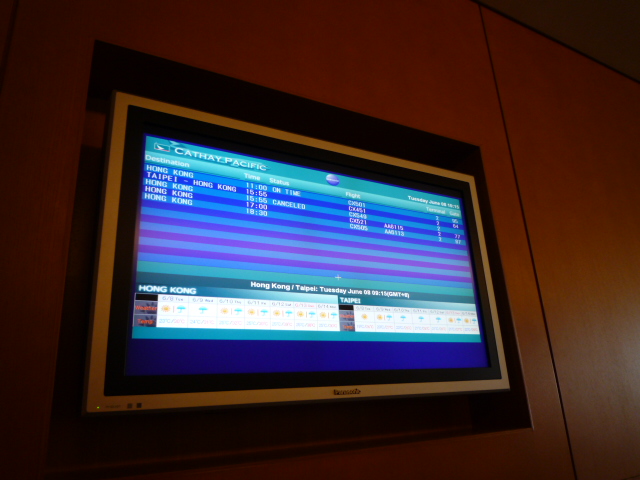 |
| The departure information screen for Cathay Pacific flights in the Cathay Pacific First & Business Class Lounge at Narita International Airport |
Airline: Cathay Pacific
Flight No.: CX 501
From: Tokyo, Narita International Airport (NRT / RJAA), Narita, Chiba, Japan
To: Hong Kong International Airport (HKG / VHHH), Hong Kong
Aircraft: Airbus A330-342
Registration No.: B-HLA
Class: Business Class
Seat No.: 16A
Date: Tuesday, 8 June 2010
After relaxing in the Cathay Pacific First & Business Class Lounge for approximately 40 minutes, the clock was already showing 10.20 a.m.. Knowing that the first boarding calls for Cathay Pacific flight CX 501 bound for Hong Kong would commence in 15 minutes' time, we immediately packed up our carry-on baggage and left the Cathay Pacific First & Business Class Lounge for the Narita International Airport Terminal 2 Shuttle System station.
Upon arrival at the Narita International Airport Terminal 2 Shuttle System station, we quickly boarded the nearest shuttle train at the platform. We were then on our way to Gate No. 95 in the Satellite Building once the doors were closed.
 |
| The Narita International Airport Terminal 2 Shuttle System station towards the Satellite Building in the Main Departure Concourse of Narita International Airport Terminal 2 as we get down towards the station |
 |
| The interior of Narita International Airport Terminal 2 Shuttle System |
Narita Airport Terminal 2 Shuttle System (Main Building to Satellite)
 |
| The Narita International Airport Terminal 2 Shuttle System station in the Satellite Building |
After we took the Narita Airport Terminal 2 Shuttle System to the Satellite Building, we finally arrived at Gate No. 95 at 10.30 a.m.. Today, Cathay Pacific flight CX 501 bound for Hong Kong would be operated using an Airbus A330-300, registered B-HLA and powered by two Rolls-Royce Trent 772-60 engines.
B-HLA was delivered to Cathay Pacific on 24 March 1995 as the first Airbus A330 ever delivered to Cathay Pacific. Originally registered VR-HLA, the aircraft received its current registration number on 15 August 1997, making the aircraft approximately 15.2 years old today.
 |
| Our aircraft for today, B-HLA, being serviced at Gate No. 95 before transporting us to Hong Kong as Cathay Pacific flight CX 501 |
 |
| The information screens at Gate No. 95 |
After five minutes of anticipated waiting, the first boarding calls for Cathay Pacific flight CX 501 bound for Hong Kong were finally made at 10.35 a.m.. The Business Class passengers, as well as the Asia Miles & Marco Polo Club members, and the passengers requiring special assistance were called to board the aircraft first.
We were on board B-HLA by 10.40 a.m., which was just in good time for an 11 o' clock departure. After we stowed all of our baggage, the flight attendant went around distributing menus and pre-departure beverages. I then requested for my usual glasses of orange juice and water, whereas my dad asked for a glass of apple juice.
The Business Class seats we were using would be the old regional type used on medium-haul routes. Despite their ageing nature, they were still quite comfortable, as seen in the better days. These seats are mainly found on the older Airbus A330s and Boeing 777s used on regional routes within Asia.
 |
| The Cathay Pacific Airbus A330-300 Old Regional Business Class cabin during the boarding process in Narita |
 |
| Pre-departure glasses of water, orange juice and apple juice |
 |
| The boarding process still being completed in Narita International Airport |
 |
| The 'no smoking' and 'fasten seatbelt' signs illuminated before pushback from Gate No. 95 |
At exactly 11 o' clock, all the aircraft doors were finally closed and we pushed back from Gate No. 95. The safety information video was shown on our video screens, and we taxied past several aircraft during our taxi to our assigned runway for take-off.
 |
| A Japan Airlines Boeing 767-346/ER aircraft parked at Gate No. 99 |
 |
| Two Japan Airlines Boeing 767s resting at Terminal 2 |
 |
| An All Nippon Airways Boeing 747-481 aircraft, registered JA8962, resting on the tarmac at Narita International Airport. Sadly, this is a sight no more for All Nippon Airways since their retirement in late 2010 |
 |
| A Delta Air Lines Boeing 777-232/ER aircraft resting on the tarmac |
 |
| One Japan Airlines Boeing 747-446 and a withdrawn Japan Airlines Boeing 747-446 resting on the tarmac |
 |
| An albino Boeing 747-400 aircraft on the tarmac, of what used to be a Japan Airlines aircraft |
Cathay Pacific Flight 501 ~ Take-off from Narita International Airport
The seatbelt sign was turned off at 11.50 a.m., 20 minutes after take-off from Narita. With that, I immediately went to the lavatory and did my usual cabin shots. From my observations in the Business Class cabin, I could tell that the flight wasn't very full. At the same time, the cabin crew sprung into action to commence the meal service.
 |
| The rear view of the Cathay Pacific Airbus A330-300 Old Regional Business Class cabin |
 |
| A view of my seat, 16A, during the flight between Narita and Hong Kong |
 |
| A warning sign in the lavatories that warns passengers that smoking in the cabin, and tampering with, disabling, or destroying smoke detectors in the lavatories is a criminal offence |
 |
| Flying somewhere between Nagoya and Osaka over a blanket of clouds |
 |
| American Airlines Boeing 777-223/ER Herpa Scale 1:500 (506663) |
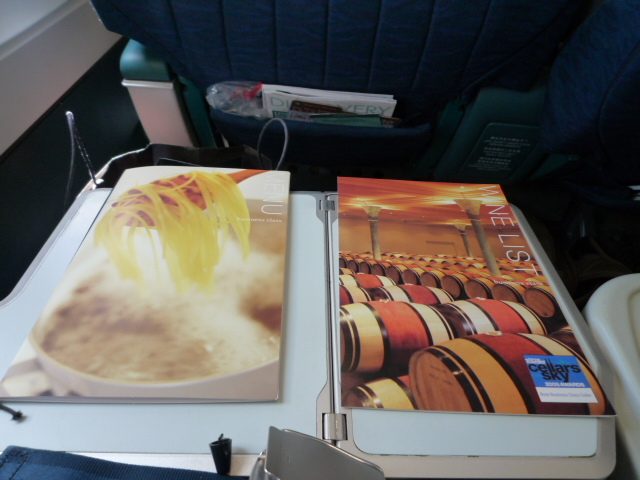 |
| The food and beverage menu and wine list resting on my tray table |
 |
| Running through the food and beverage menu for the sector between Tokyo and Hong Kong |
 |
| A closer look into the food and beverage menu for the sector between Tokyo and Hong Kong |
 |
| A look into the wine list for the sector between Tokyo and Hong Kong |
A few minutes later, a Filipino flight attendant, named Ina, came to my seat to take my order for the in-flight meal service. Surprisingly, she addressed me by name, as well as my brother.
Eagerly, I told Ina that I would like to have the grilled beef tenderloin with mushroom tarragon sauce, sautéed potatoes and roasted vegetables. I also requested for a glass of apple juice at the same time.
Immediately, Ina went back to the galley to bring me some mixed nuts and set up my table. My starter was brought out after that.
 |
| A small plate of mixed nuts for myself |
 |
| A glass of apple juice for myself |
 |
| Flying somewhere over Kyushu |
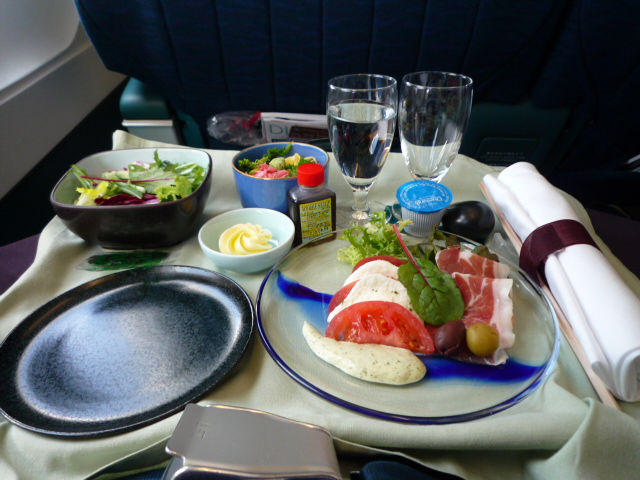 |
| The first course: Prosciutto with tomato, mozzarella and pesto mayonnaise |
After approximately 25 minutes of waiting, Ina emerged from the galley with my grilled beef tenderloin with mushroom tarragon sauce, sautéed potatoes and roasted vegetables. With that, I tucked into my main meal. When I took the first cut and bite from the beef, it tasted actually quite tender and not overdone. The sautéed potatoes and the mushroom sauce went pretty well with the beef too.
 |
| My main course: Grilled beef tenderloin with mushroom tarragon sauce, sautéed potatoes and roasted vegetables |
After I finished my main course, Ina came to clear my plates and cutlery, and asked me whether I wanted anything else. To round of this hearty meal, I requested for a small tub of Strawberry-flavoured Häagen-Dazs ice cream. It was brought to me 10 minutes later. After finishing it off, I decided to take a short nap.
 |
| My small tub of Strawberry-flavoured Häagen-Dazs ice cream on my table |
 |
| Flying somewhere over the Taiwan Strait between Japan and Taiwan |
After having a 2-hour nap, I woke up at 2.25 p.m.; the seatbelt sign was illuminated at the same time, in preparation for the landing into Hong Kong International Airport. Immediately, we stowed away all of our carry-on baggage, and buckled up for the landing.
After a flight time of 4 hours 15 minutes from Tokyo's Narita International Airport, we finally touched down in Hong Kong International Airport at 2.45 p.m., in accordance with the Hong Kong local time. Here are some pictures I took during descent and after landing.
Shortly after we landed in HKG, the flight attendants made a special announcement for my brother, in which they wished him a "Happy 10th Birthday". We were all amazed by this. They even gave him a birthday card before landing.
 |
| The 'no smoking' and 'fasten seatbelt' signs illuminated in preparation for landing into HKG |
 |
| Flying over a Taiwanese island |
 |
| Flying between Taiwan and Hong Kong |
 |
| Flying between some dark clouds over the South China Sea while getting closer into Hong Kong International Airport |
 |
| The overall view of the South China Sea while descending into Hong Kong International Airport |
 |
| The South China Sea while descending closer into Hong Kong |
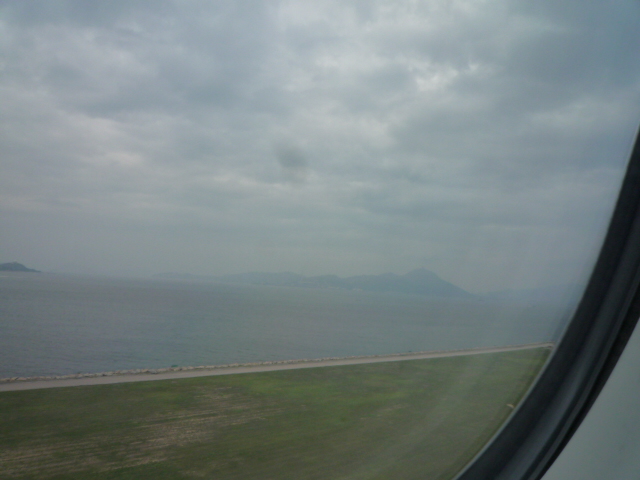 |
| Finally touching down into Hong Kong International Airport |
 |
| A British Airways Boeing 747-436 resting on the tarmac at Hong Kong International Airport |
After 10 minutes of taxiing along the tarmac, we finally docked onto our assigned arrival gate at 2.55 p.m.. As soon as the seatbelt sign was turned off, we took all of our carry-on baggage and disembarked the aircraft.
All the flight attendants, including Ina, bade us a pleasant journey back home to Singapore.
The grading system for each airline and sector are as follows:
A+: 85% or above (Airline has an excellent rating and performance)
A: 75% ~ 84% (Airline has a good rating and performance)
B: 60% ~ 74% (Airline has a good rating and performance)
C: 50% ~ 59% (Airline has an adequate rating and performance)
D: 40% ~ 49% (Airline has a fair rating and performance)
E: 20% ~ 39% (Airline has a poor rating and performance)
U: Below 20% (Airline has not met the requirement for the minimum grade)
Cathay Pacific Flight 501 Score ReportSeat: 18 / 20
Food: 17 / 20
Service: 18 / 20
Aircraft cleanliness: 17 / 20
Legroom space: 17 / 20
Total: 87 / 100
In total, Cathay Pacific scored 87% for the sector between Tokyo (Narita) and Hong Kong, which means they deserve an 'A+' grade, the highest airline grade. It was indeed quite another good flight with the airline.
Part 3 ~ Layover in Hong Kong & The Flight Back Home to Singapore
After disembarking from Cathay Pacific flight CX 501 from Tokyo (Narita), we immediately headed towards the connection flight security checkpoint in preparation for the next sector back home to Singapore. As with all security checks, this one was quick enough, and we were soon in the airside by 3.10 p.m..
Feeling that there was still time to spare, we decided to head over to one of the Cathay Pacific First & Business Class Lounges to have some light bites and beverages before the flight back home to Singapore.
The first impression of the lounge was that there were not many people in the lounge. The food selections were limited and a bit outdated. Hopefully, there would be a renovation to make the lounge look like a better place in the near future.
 |
| The immigrations area in Hong Kong International Airport |
 |
| The transit mall in Hong Kong International Airport |
 |
| The departure flight information screen in the airside of Hong Kong International Airport |
 |
| The view of the busy airside of Hong Kong International Airport |
 |
| Approaching the entrance to the Cathay Pacific First & Business Class Lounge in Hong Kong International Airport |
 |
| The interior of the Cathay Pacific First & Business Class Lounge in Hong Kong International Airport |
 |
| The design of the ceiling in Hong Kong International Airport in the Cathay Pacific First & Business Class Lounge |
 |
| A plate of chicken on a stick and two potato rings for myself |
 |
| Several aircraft resting on the tarmac in Hong Kong International Airport as seen from the Cathay Pacific First & Business Class Lounge |
Airline: Cathay Pacific
Flight No.: CX 711 (Flight continues on to Colombo)
From: Hong Kong International Airport (HKG / VHHH), Hong Kong
To: Singapore Changi Airport (SIN / WSSS), Singapore
Aircraft: Boeing 777-267
Registration No.: B-HNA
Class: Business Class
Seat No.: 18K
Date: Tuesday, 8 June 2010
After some short relaxations in the Cathay Pacific First & Business Class Lounge, the clock was already showing 3.40 p.m.. Knowing that boarding for Cathay Pacific flight CX 711 bound for Singapore and Colombo was already boarding, we packed up all our carry-on baggage and left the lounge for the airport buggy counter, as Gate No. 62 was located quite far from where we were.
At the airport buggy counter, we arranged for a buggy to transport us to Gate No. 62 for Cathay Pacific flight CX 711 bound for Singapore and Colombo. Once the airport buggy had arrived, the driver helped to load our baggage, and we were on our way for a fast run to Gate No. 62.
 |
| The Shuttle Buggy counter area in Hong Kong International Airport |
 |
| A lineup of duty-free shops in Hong Kong International Airport |
 |
| The passageway towards Gates No. 25 to 80 in Hong Kong International Airport |
After a very fast airport buggy ride, we arrived at Gate No. 62 at 3.55 p.m., just in time for our flight back to Singapore. At the same time, the last minute passengers were already boarding the aircraft. The aircraft operating on Cathay Pacific flight CX 711 bound for Singapore and Colombo was a Boeing 777-200, registered B-HNA, the same aircraft that ferried us from Singapore to Hong Kong earlier on 27 May (Thursday).
As soon as our boarding passes were examined, we were on board B-HNA by 4.05 p.m., just in time for a good 4.15 p.m. departure. We would be scheduled to land in Singapore Changi Airport at 8 o' clock later that night. Pre-departure drinks were offered as usual to the Business Class passengers. I then ordered my usual glass of orange juice before the doors were closed for departure.
As soon as our boarding passes were examined, we were on board B-HNA by 4.05 p.m., just in time for a good 4.15 p.m. departure. We would be scheduled to land in Singapore Changi Airport at 8 o' clock later that night. Pre-departure drinks were offered as usual to the Business Class passengers. I then ordered my usual glass of orange juice before the doors were closed for departure.
 |
| Our aircraft for today, B-HNA, being prepared to ferry us back home to Singapore as Cathay Pacific flight CX 711. This was the same plane that ferried us from Singapore to Hong Kong on Thursday, 27 May |
 |
| The Cathay Pacific Boeing 777-200 Business Class cabin during the eleventh hour boarding process |
 |
| My usual pre-departure glass of orange juice |
At exactly 4.15 p.m., the doors were closed and we pushed back from our departure gate. At the same time, the safety information briefing video was shown on the screen. We then taxied to our assigned runway for take-off. After a 20-minute taxi to our assigned runway, we finally lifted off from Hong Kong International Airport at 4.35 p.m., heading into the early evening sky for a flight time of 3 hours 20 minutes over the South China Sea towards the Republic of Singapore.
 |
| Lining up for take-off |
 |
| Tung Chung New Town, as seen from Cathay Pacific flight CX 711 bound for Singapore, shortly after take-off from Hong Kong International Airport |
 |
| Climbing over a blanket of clouds |
The seatbelt sign was turned off at 4.50 p.m., approximately 15 minutes into the flight. At the same time, the cabin crew sprung into action to begin the meal service. As I looked closer into the food menu, a flight stewardess came up to me to take my main course order. I decided to have the beef stroganoff with buttered spaetzle and green beans.
A plate of warm almond nuts was brought to me at my table. I then ate them quickly and did my usual cabin shots before my appetizer arrived at my dining table. Here are some pictures of the cabin and my appetizer.
 |
| The Cathay Pacific Boeing 777-200 Business Class cabin shortly after the seatbelt sign was turned off |
 |
| The food and beverage menu for the flight between Hong Kong and Singapore |
 |
| A closer look into the food and beverage menu for the flight between Hong Kong and Singapore |
 |
| A plate of warm almond nuts on my centre armrest |
 |
| The Cathay Pacific Boeing 777-200 Business Class cabin during the meal service |
 |
| A view of my seat, 18K, during the flight between Hong Kong and Singapore |
 |
| My first course: Smoked peppered tuna Niçoise salad with tomato dressing |
After approximately 15 minutes of waiting, the flight attendant finally reappeared at my dining table with my beef stroganoff with buttered spaetzle and green beans. I then tucked into my main in-flight dinner. The beef tasted quite tender, and the greens beans went well with the juicy beef sauce. The buttered spaetzle was another good accompaniment to this fine in-flight meal service.
After finishing off my sumptuous beef stroganoff, the flight attendant came by to clear away my main meal tray and asked whether I wanted anything else. To round off this wonderful dinner, I requested for a plate of espresso truffle cake with mascarpone cream and vanilla sauce. While she cleared away my meal tray and went back to the galley, I went to the lavatory again before settling down again.
20 minutes later, the flight attendant re-appeared from the galley with my dessert and hot chocolate. I then tucked into my dessert. The espresso truffle cake tasted perfect, with just the right pints of chocolate. This was a perfect way to round off such a wonderful dinner.
When I was finally done with my desserts, the flight attendant cleared away my mug and tray. I was then left in peace to enjoy the remainder of the flight.
The seatbelt sign was illuminated at 7.40 p.m., 15 minutes in preparation for descent into Singapore Changi Airport. Immediately, we stowed away all of our carry-on baggage and buckled up for the landing into our homeland. After a flight time of 3 hours 20 minutes from Hong Kong, we finally touched down in Singapore Changi Airport at 7.55 p.m., five minutes ahead of schedule.
After taxiing on the tarmac for approximately 10 minutes, we finally docked onto our arrival gate, which was Gate No. D42, at 8.05 p.m.. As soon as the seatbelt sign was turned off, we got up and took all our carry-on baggage before exiting the aircraft. The passengers bound for Colombo, Sri Lanka had the choice of either disembarking the aircraft or remaining on board during the stopover in Singapore.
As we disembarked the aircraft, all the flight attendants bade us farewell and wished us a pleasant journey back home.
Cathay Pacific Flight 711 Score Report
Seat: 18 / 20
Food: 16 / 20
Service: 17 / 20
Aircraft cleanliness: 17 / 20
Legroom space: 17 / 20
Total: 85 / 100
In total, Cathay Pacific scored 85% for the sector between Hong Kong and Singapore, which means they deserve another 'A+' grade, the highest airline grade. It was indeed quite another good flight with the airline. Cathay Pacific now remains one of the airlines I am fond of most in my travels.
After disembarking from Cathay Pacific flight CX 711 from Hong Kong, we walked along the concourse of Terminal 1 towards the immigrations area via the arrival escalators. We then cleared immigration through the fingerprint checkpoint, which is reserved exclusively for Singaporean citizens and permanent residents of Singapore.
As soon as we cleared the immigrations area, I went to check the baggage belt information screen to see where our check-in baggage would be arriving. According to the baggage belt information screen, all check-in baggage for Cathay Pacific flight CX 711 bound for Hong Kong would be arriving at Belt No. 23.
Without wasting anymore time, we went to get three baggage trolleys. While my mum went to shop for some duty-free items, I followed my brother and my dad to Belt No. 23 to claim our check-in baggage.
After we had claimed all our check-in baggage from Belt No. 23, we went into the arrival towards a MaxiCab counter to arrange for a MaxiCab to transport us back home. The arrival hall was relatively crowded, as there were lots of people, with most travellers visiting Singapore either for business or for leisure purposes.
As soon as we went to the MaxiCab counter and made our MaxiCab arrangements to take us home, a well-dressed MaxiCab driver came to meet us in the arrival hall. Once he took us to the pick-up area, he helped us to load our baggage into the boot of his cab. By 8.35 p.m., we were on our way back for home.
After arriving back in the familiar surroundings of our home at 9 o' clock, my housekeeper met us outside and helped us unload our baggage. That night, we had supper and tired but happy, we were glad to be home. To summarise, I can safely say that I enjoyed this trip to Japan as I had the chance to touch Honshu again, for the first time in two years. I shall go there again when I get the chance to do so.
 |
| My main course: Beef stroganoff with buttered spaetzle and green beans |
After finishing off my sumptuous beef stroganoff, the flight attendant came by to clear away my main meal tray and asked whether I wanted anything else. To round off this wonderful dinner, I requested for a plate of espresso truffle cake with mascarpone cream and vanilla sauce. While she cleared away my meal tray and went back to the galley, I went to the lavatory again before settling down again.
20 minutes later, the flight attendant re-appeared from the galley with my dessert and hot chocolate. I then tucked into my dessert. The espresso truffle cake tasted perfect, with just the right pints of chocolate. This was a perfect way to round off such a wonderful dinner.
When I was finally done with my desserts, the flight attendant cleared away my mug and tray. I was then left in peace to enjoy the remainder of the flight.
 |
| My perfect dessert: Espresso truffle cake with mascarpone cream and vanilla sauce |
 |
| The powerful Rolls-Royce Trent 877 engine spooling us over the South China Sea |
 |
| My mug of hot chocolate on my dining tray |
 |
| The Cathay Pacific Boeing 777-200 Regional Business Class cabin during cruising altitude over the South China Sea |
 |
| Cruising through a blanket of clouds over the South China Sea |
 |
| My personal video screen indicating that we had 35 minutes left before descent into Singapore |
 |
| Flying through more clouds over the South China Sea as the sun begins to set |
 |
| The Cathay Pacific Boeing 777-200 Regional Business Class cabin shortly before the seatbelt sign was illuminated before descent into Singapore Changi Airport |
The seatbelt sign was illuminated at 7.40 p.m., 15 minutes in preparation for descent into Singapore Changi Airport. Immediately, we stowed away all of our carry-on baggage and buckled up for the landing into our homeland. After a flight time of 3 hours 20 minutes from Hong Kong, we finally touched down in Singapore Changi Airport at 7.55 p.m., five minutes ahead of schedule.
 |
| Flying over a blanket of clouds during approach towards Singapore as the sun sets |
Cathay Pacific Flight 711 ~ Landing in Singapore Changi Airport
 |
| Taxiing past a SilkAir Airbus A320 at Terminal 2 |
After taxiing on the tarmac for approximately 10 minutes, we finally docked onto our arrival gate, which was Gate No. D42, at 8.05 p.m.. As soon as the seatbelt sign was turned off, we got up and took all our carry-on baggage before exiting the aircraft. The passengers bound for Colombo, Sri Lanka had the choice of either disembarking the aircraft or remaining on board during the stopover in Singapore.
As we disembarked the aircraft, all the flight attendants bade us farewell and wished us a pleasant journey back home.
Cathay Pacific Flight 711 Score Report
Seat: 18 / 20
Food: 16 / 20
Service: 17 / 20
Aircraft cleanliness: 17 / 20
Legroom space: 17 / 20
Total: 85 / 100
In total, Cathay Pacific scored 85% for the sector between Hong Kong and Singapore, which means they deserve another 'A+' grade, the highest airline grade. It was indeed quite another good flight with the airline. Cathay Pacific now remains one of the airlines I am fond of most in my travels.
After disembarking from Cathay Pacific flight CX 711 from Hong Kong, we walked along the concourse of Terminal 1 towards the immigrations area via the arrival escalators. We then cleared immigration through the fingerprint checkpoint, which is reserved exclusively for Singaporean citizens and permanent residents of Singapore.
As soon as we cleared the immigrations area, I went to check the baggage belt information screen to see where our check-in baggage would be arriving. According to the baggage belt information screen, all check-in baggage for Cathay Pacific flight CX 711 bound for Hong Kong would be arriving at Belt No. 23.
Without wasting anymore time, we went to get three baggage trolleys. While my mum went to shop for some duty-free items, I followed my brother and my dad to Belt No. 23 to claim our check-in baggage.
 |
| The busy airside in Singapore Changi Airport Terminal 1 with lots of travellers beginning to crowd around it |
 |
| The immigrations area in Singapore Changi Airport Terminal 1 |
 |
| A duty-free shop located close to the baggage claiming area in Singapore Changi Airport Terminal 1 |
 |
| The baggage belt information screen indicating that all check-in baggage from Cathay Pacific flight CX 711 from Hong Kong would arrive at Belt No. 23 |
 |
| The arrival flight information screen in the baggage claiming area in Singapore Changi Airport Terminal 1 |
 |
| The baggage claiming area in Singapore Changi Airport Terminal 1 |
After we had claimed all our check-in baggage from Belt No. 23, we went into the arrival towards a MaxiCab counter to arrange for a MaxiCab to transport us back home. The arrival hall was relatively crowded, as there were lots of people, with most travellers visiting Singapore either for business or for leisure purposes.
 |
| The arrival hall in Singapore Changi Airport Terminal 1 |
As soon as we went to the MaxiCab counter and made our MaxiCab arrangements to take us home, a well-dressed MaxiCab driver came to meet us in the arrival hall. Once he took us to the pick-up area, he helped us to load our baggage into the boot of his cab. By 8.35 p.m., we were on our way back for home.
After arriving back in the familiar surroundings of our home at 9 o' clock, my housekeeper met us outside and helped us unload our baggage. That night, we had supper and tired but happy, we were glad to be home. To summarise, I can safely say that I enjoyed this trip to Japan as I had the chance to touch Honshu again, for the first time in two years. I shall go there again when I get the chance to do so.
This now officially brings my blog report about my summer vacation in Japan in May and June 2010 to a close. I trust that you have enjoyed reading this blog report, and thank you very much for your attention. I hope that you have a happy blogging experience, and there are much more interesting posts to come.
登録:
投稿 (Atom)
-
 Ladies & Gentlemen, as the Northern Hemisphere mid-summer season rapidly approaches its peak, I hope you will accept my most sincere apo...
-
Welcome to the second segment of my special mid-summer birthday vacation to Japan in June 2015. This segment of the blog report will cov...
-
 Dear bloggers, as we all progress through the Northern Hemisphere autumn season, please do accept my apologies for the shortage of overseas ...
